Every detail is rigorously monitored and repeatedly tested according to all industry standards. The most important standard for us is EN 13300 for “Coating materials for interior walls and ceilings”
Classification according to EN 13300
You can count on it
When you choose Brillux interior paints, you choose genuine quality. From testing the raw materials and monitoring the production steps to processing the paints and ensuring the quality of the finished surface.
We are strict with ourselves
EN 13300
Two letters, five numbers and what they mean
Anyone can promise quality. The EN 13300 classification guarantees comparable values for all products – and for you when you use them.
So you can be sure you’re using guaranteed quality. And pass this promise on to your customers with peace of mind.
Because we want your customers to be satisfied. And you too, of course!

Wet abrasion resistance
The quality criterion
Wet abrasion resistance is an indicator of a surface’s resistance. The measure for resistance to mechanical abrasion, e.g. when cleaning the surface, is divided into five R-classes. R-class 1 represents the highest wet abrasion resistance, R-class 5 the lowest.
R-class | Wet abrasion resistance |
|---|
The classification criterion “gloss”
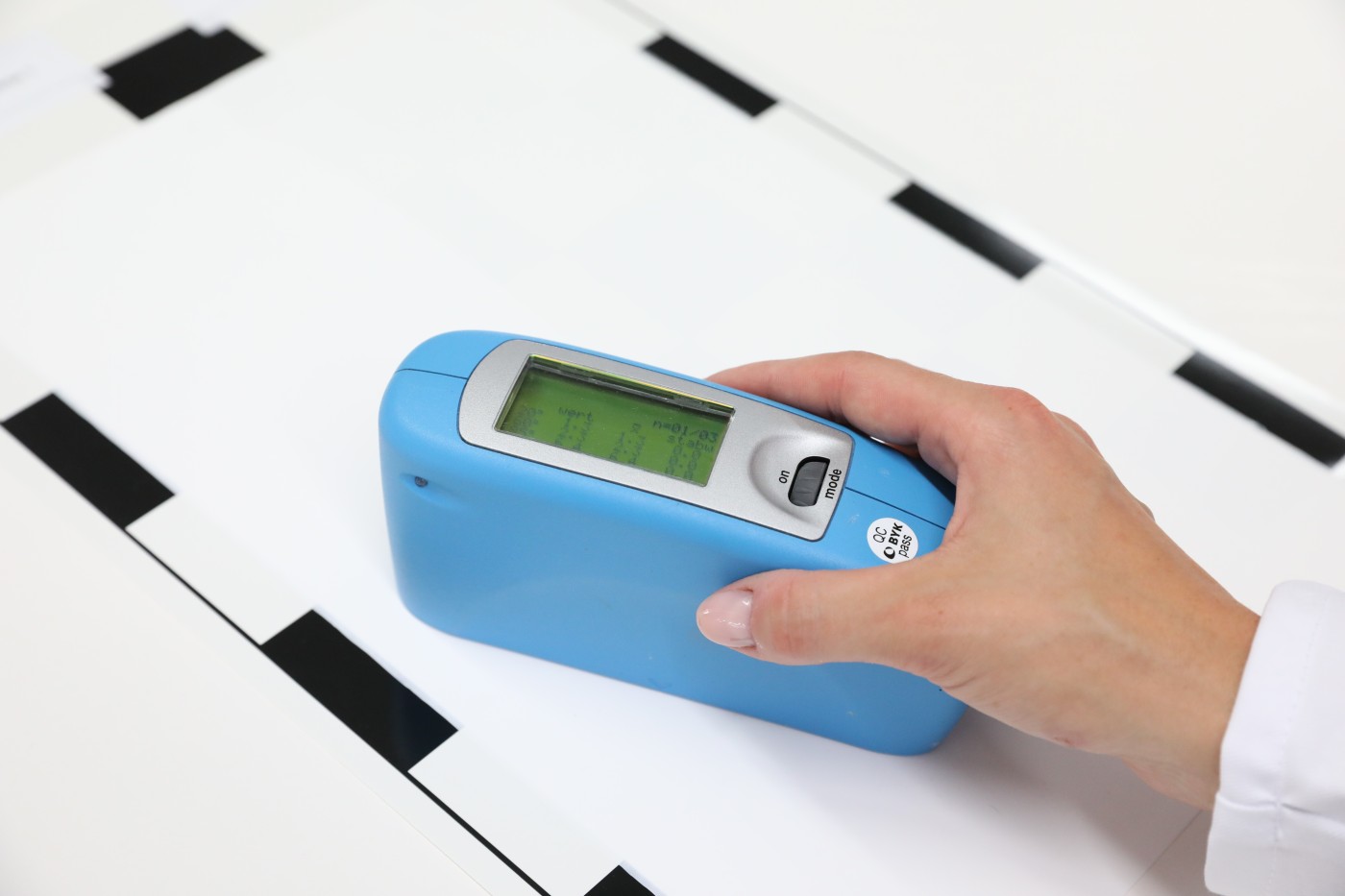
The gloss grade is determined using a reflectometer or gloss measuring unit in accordance with EN 13300. The gloss grade is measured at angles of 60° and 85°. Measurements must be taken on a smooth surface. EN 13300 distinguishes between four gloss grades: the gloss grade “medium gloss” can also be referred to as, for example, silk gloss or silk matt and is therefore subdivided into the subcategories G2a and G2b, depending on the measuring angle and gloss grade.- G1 glossy
- G2 medium gloss (G2a and G2b)
- G3 matt
- G4 dull matt
Matt coats hide imperfections in walls painted in grazed light, while medium-gloss or high-gloss grades can make uneven areas more visible.


The quality criterion “contrast ratio”
The contrast ratio indicates whether the interior paint is able to cover a contrasting substrate. The contrast ratio is assigned one of four classes depending on the paint’s covering rate (m²/l): H10 class 1 has the highest hiding power and H10 class 4 has the lowest (example: H10 class 1 at 7 m²/l).
H₁₀ classes | Hiding power % |
|---|

“Maximum grain size”
The maximum grain size describes the size of the largest particles of an interior emulsion. The grain size is determined and tested using a grindometer. Most wall paint features a fine grain size. Grained coatings, for example Vetrolux 3100 or all brush-on renders, have medium grain size. The classification “coarse” is mainly found in structural plasters.
Description | Grain size |
|---|
The classification criterion “cleanability”
This quality feature was introduced in 2023 without classification. It defines the ability of a (pigmented) coating to withstand stain removal without any perceptible change in surface structure, gloss or color. The stain may be removed, for example, using a soft sponge moistened with a suitable medium (clean water, water mixed with cleaning product, solvent) depending on the type of soiling, without scrubbing too hard. A coating with an R-class ≥ 3 must not be declared as cleanable.

